Lead-Acid to LiFePO4 Conversion: The Complete Upgrade Guide

If your RV, boat, off-grid cabin, or backup bank still runs on lead-acid, you are carrying dead weight — literally. Here is the engineer’s playbook for converting to LiFePO4 without frying your charger or your budget.
The Hidden Cost of Lead-Acid
Flooded and AGM lead-acid batteries feel cheap at the counter, but the ownership math is brutal:
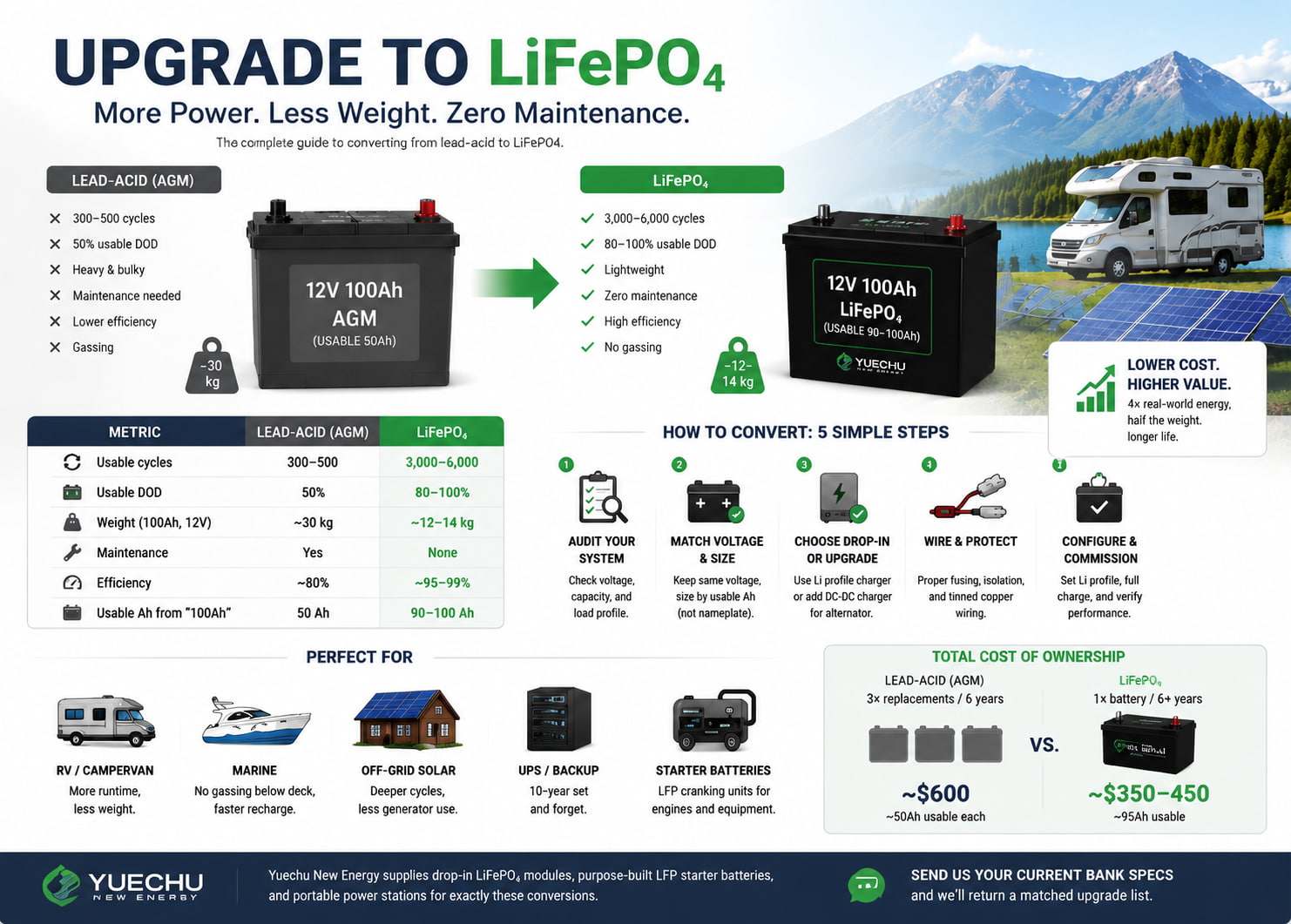
- 300–500 cycles before capacity collapses.
- 50% usable DOD — a “100 Ah” battery gives you 50 Ah.
- Sulfation if left partially charged; a slow death.
- Maintenance — topping up water, equalizing, cleaning corrosion.
- Weight — 2–3× heavier than LFP for the same energy.
- Gassing — hydrogen off-gassing needs ventilation.
Over a 10-year horizon you buy 3–4 lead-acid sets to match one LiFePO4 pack.
Why LiFePO4 Is the Upgrade
| Metric | Lead-Acid (AGM) | LiFePO4 |
|---|---|---|
| Usable cycles | 300–500 | 3,000–6,000 |
| Usable DOD | 50% | 80–100% |
| Weight (100 Ah, 12 V) | ~30 kg | ~12–14 kg |
| Maintenance | Yes | None |
| Efficiency | ~80% | ~95–99% |
| Usable Ah from “100 Ah” | 50 Ah | 90–100 Ah |
Net effect: a single 100 Ah LFP delivers roughly 4× the real-world energy of a 100 Ah AGM over its life, at half the weight.
Step 1 — Audit Your Existing Bank
Record:
- System voltage (12 V / 24 V / 48 V).
- Bank capacity in Ah and the configuration (e.g., 2× 12 V 100 Ah in series = 24 V 100 Ah).
- Load profile — peak amps (starter motor, inverter surge) and average draw.
Step 2 — Match Voltage, Then Size Usable Ah
Keep the same nominal voltage. For capacity, size to usable Ah, not nameplate:
- If your lead-acid gave 50 Ah usable (100 Ah × 50%), a 100 Ah LFP already doubles your runtime (90–100 Ah usable).
- For starter / cranking duty (铅改锂启动电池), confirm the LFP cell can deliver the required CCA-equivalent pulse current — use a purpose-built LFP starter unit, not a deep-cycle pack.
Step 3 — Drop-In or System Redesign?
Drop-in LFP (internal BMS, same footprint): works with most lead-acid chargers because it presents a normal 12/24/48 V terminal. Caveat: lead-acid chargers use an absorption/float profile that under-charges LFP slightly and never triggers a full balancing cycle. You’ll get 90–95% performance — fine for most users.
Optimized redesign: switch the charger / solar controller to a “Li” profile (constant-current then constant-voltage, no float trickle). You unlock full capacity, active balancing, and longest life. Cost: a new charger or a firmware setting.
Alternator charging (vehicles/boats): a “dumb” alternator can over-drive an LFP and cook it. Use a DC-DC charger (e.g., 12→12 V, current-limited) between alternator and battery. Non-negotiable for engine-started systems.
Step 4 — Wiring, Fusing, Isolation
- Do not mix chemistries in one bank — never parallel old lead-acid with new LFP.
- Downsize isn’t automatic: current stays the same, but LFP’s low internal resistance means higher fault current — keep proper fusing (Class T or MRBF) close to the positive terminal.
- Use tinned copper in marine/RV environments; torque all lugs.
- Add a master disconnect for service.
Step 5 — Configure and Commission
- Set charger / MPPT to LiFePO4 (bulk ~14.4–14.6 V for 12 V systems, absorption same, no extended float — or float at 13.6 V).
- Let the BMS auto-balance on first full charge (leave it plugged in 24 h).
- Verify state-of-charge against a known load test.
Use Cases We See Weekly
- RV / campervan: half the weight, doubles boondocking time.
- Marine: no gassing below deck, faster recharge from solar.
- Off-grid solar: deeper daily cycling, less generator runtime.
- UPS / telecom backup: 10-year set-and-forget.
- Starter batteries: LFP cranking units for diesel gensets and ATVs.
Total Cost of Ownership
A 12 V 100 Ah AGM (~$200) lasts ~2 years of daily cycling. Three replacements over 6 years = ~$600, delivering ~50 Ah usable each. One 12 V 100 Ah LFP (~$350–450) lasts the full 6+ years at ~95 Ah usable. Lower cost per usable amp-hour-life, zero maintenance, half the weight.
Final Thoughts
Converting to LiFePO4 is the highest-ROI upgrade you can make to any battery-powered system. Audit, match voltage, add a DC-DC charger for engine systems, fuse properly, and let the BMS do its job.
Yuechu New Energy supplies drop-in LiFePO4 modules, purpose-built LFP starter batteries, and portable power stations for exactly these conversions. Send us your current bank specs and we’ll return a matched upgrade list.