Lithium Battery vs Lead-Acid Battery: The Complete 2026 Comparison

If you are shopping for a solar backup system, an off-grid power bank, a UPS, or a replacement for worn-out batteries in an RV, boat, or telecom site, the first question is almost always the same: lithium or lead-acid?
This guide gives you the honest, engineering-level answer — no marketing fluff. We compare lithium (specifically LiFePO4, the lithium iron phosphate chemistry used in serious energy storage) against flooded, AGM, and gel lead-acid batteries across every metric that actually affects your wallet and your uptime.
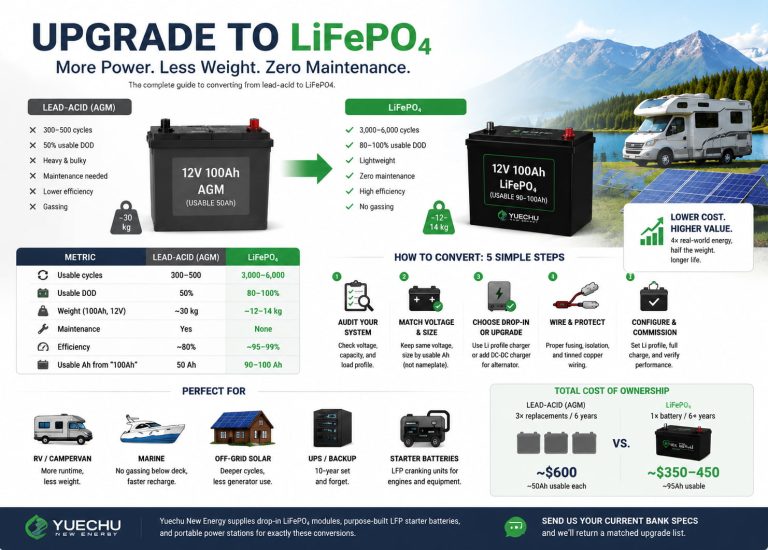
Bottom line up front: For almost any application that needs deep, frequent cycling — solar storage, backup power, off-grid, or engine starting — LiFePO4 delivers 4–8× the usable life of lead-acid at a lower true cost per kWh over the system lifetime, with half the weight and virtually zero maintenance. Lead-acid only wins on one thing: the lowest upfront sticker price for very small, lightly used systems.
1. Why This Comparison Matters in 2026
Grid instability, rising diesel costs, and falling solar prices have pushed energy storage from a luxury to a necessity across Africa, the Middle East, South Asia, and remote installations worldwide. At the same time, lithium battery prices have dropped to the point where the total cost of ownership (TCO) of LiFePO4 is now lower than lead-acid in most real-world scenarios.
Yet lead-acid is still marketed on its low purchase price. The gap between “cheap to buy” and “cheap to own” is exactly where most buyers lose money. This article closes that gap.
2. How They Work (In Plain Terms)
| Lead-Acid | LiFePO4 (Lithium Iron Phosphate) | |
|---|---|---|
| Chemistry | Lead plates in sulfuric acid | Lithium iron phosphate cathode |
| Nominal cell voltage | 2.0 V | 3.2 V |
| Energy conversion | Chemical ↔ electrical via lead sulfate | Intercalation of lithium ions |
| Thermal runaway threshold | Lower; acid can vent/gas | Very high (~270°C); inherently stable |
The single most important difference is how deeply you can discharge them. Lead-acid suffers permanent damage if you regularly use more than ~50% of its capacity. LiFePO4 comfortably delivers 80–90% depth of discharge (DOD) for thousands of cycles without meaningful degradation.
3. Head-to-Head Comparison Table
| Parameter | Lead-Acid (Flooded/AGM/Gel) | LiFePO4 (Lithium) | Winner |
|---|---|---|---|
| Cycle life @ 80% DOD | 300–600 cycles | 3,000–6,000+ cycles | LiFePO4 |
| Usable capacity (DOD) | 50% (max safe) | 80–90% | LiFePO4 |
| Round-trip efficiency | 70–85% | 95–98% | LiFePO4 |
| Weight (same energy) | 2.5–3× heavier | Lightest | LiFePO4 |
| Maintenance | Top-up water, equalize (flooded) | None | LiFePO4 |
| Self-discharge / month | 5–15% | 2–3% | LiFePO4 |
| Operating temp range | Narrow; freezes risk | Wide; BMS-managed | LiFePO4 |
| Safety (thermal/venting) | Acid venting, gassing | Stable, no acid, no gassing | LiFePO4 |
| Upfront price | Low | 2–3× lead-acid | Lead-Acid |
| 10-year true cost | High (multiple replacements) | Low (often 1 unit) | LiFePO4 |
4. Total Cost of Ownership — The Real Story
Lead-acid looks cheap on day one. It is the most expensive battery you can own over 10 years.
Worked example — a 5 kWh daily storage need:
- Lead-acid: To safely use 50% DOD, you must buy ~10 kWh of nameplate. At ~$150/kWh nameplate that is ~$1,500. It lasts ~400 cycles (≈1–1.5 years of daily use), so over 10 years you replace it 6–8 times → $9,000–$12,000, plus labor, plus water/equalization time.
- LiFePO4: 5 kWh usable needs ~5–6 kWh nameplate at 90% DOD. At ~$300/kWh that is ~$1,800. It lasts 3,000–6,000 cycles (≈8–15 years) → one purchase, near-zero maintenance.
Result: LiFePO4 costs roughly one-third to one-half of lead-acid per usable kWh over the system life, while taking up less space and needing no maintenance visits.
5. Why LiFePO4 Wins for Solar, Backup & Off-Grid
- You capture more of your solar. 95–98% round-trip efficiency vs 70–85% means less energy lost charging and discharging — directly more free power from the same panels.
- Deeper daily use without damage. 80–90% DOD lets a smaller battery do the job a much larger lead-acid bank would be needed for.
- No downtime from maintenance. No watering, no equalization, no acid spills — critical for remote sites where a service trip costs more than the battery.
- Stable in heat. With a proper BMS, LiFePO4 handles high-ambient climates (common in Nigeria, the Gulf, South Asia) far better than flooded lead-acid, which loses capacity and life fast in heat.
- Inherent safety. LiFePO4 is the only lithium chemistry that is non-combustible under abuse; it does not release oxygen and will not support chain thermal runaway the way other lithium chemistries can.
6. When Lead-Acid Still Makes Sense (An Honest View)
We sell lithium, but we will tell you straight: lead-acid is acceptable when all of these are true:
- Very low daily throughput (occasional use, e.g. a rarely used gate opener)
- Tightest possible upfront budget and short expected ownership
- Someone available to maintain/water it regularly
- Weight and space are not constraints
If you cycle it daily, need it to last, or cannot service it — lithium is the rational choice.
7. Can You Replace Lead-Acid with Lithium Directly?
In most 12V/24V systems, yes — with one critical caveat: you need a lithium-compatible charger / BMS-aware charge profile. Lead-acid chargers use absorption/float stages and sometimes equalization voltages that can over-charge or confuse a LiFePO4 BMS.
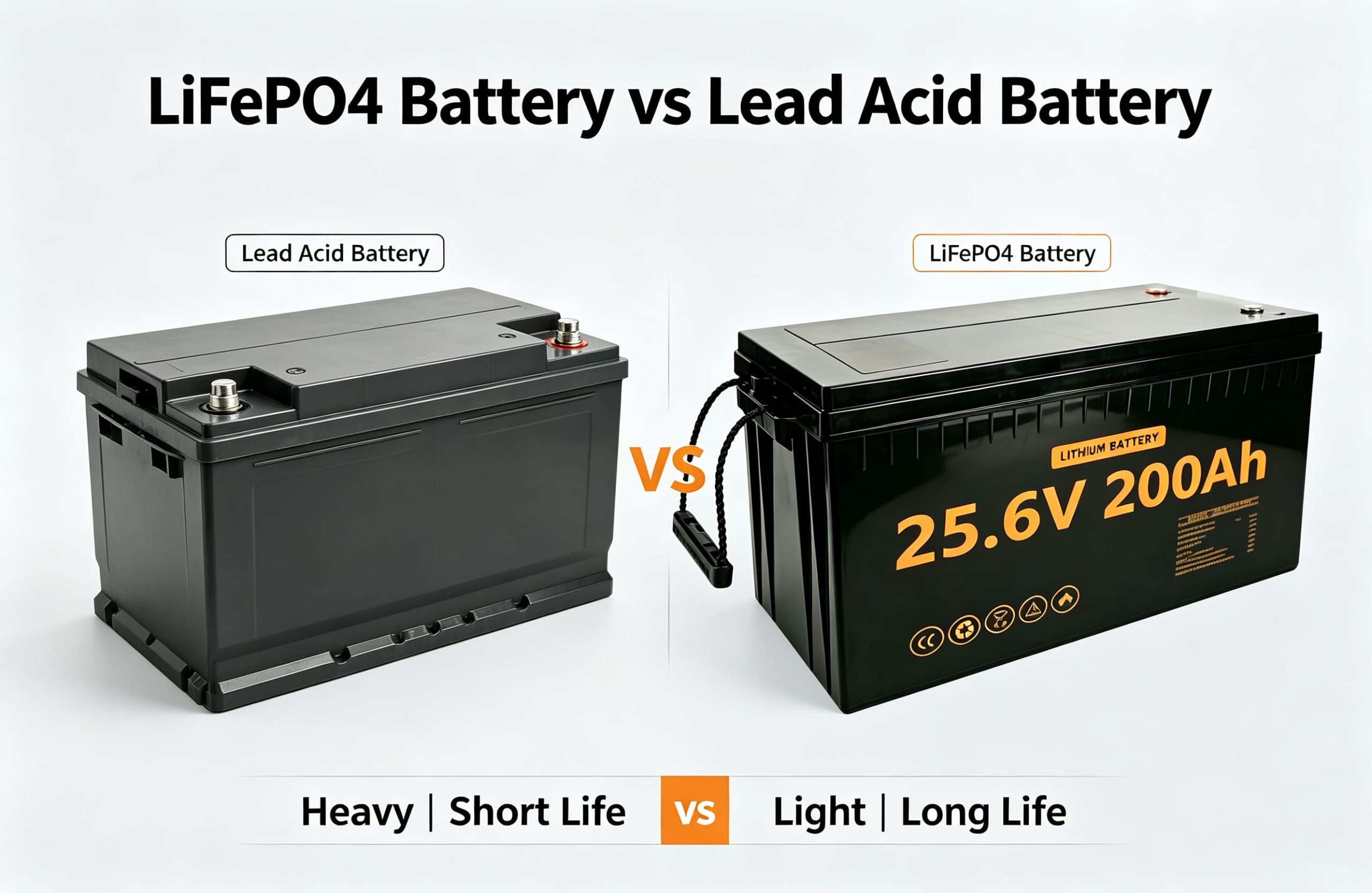
- Drop-in replacement: Many 12.8V / 25.6V LiFePO4 batteries are built to the same footprint as the lead-acid they replace and include an internal BMS that tolerates standard alternator / solar input. Ideal for RVs, boats, and UPS swaps.
- 12V lead-acid → 12.8V lithium: Direct physical swap; verify your charger has a “Li” mode or use a DC-DC charger for alternator charging.
- Higher-voltage systems: For 48V banks and above, size the battery rack and inverter together — this is where a proper ESS design (not a simple swap) pays off.
Circova’s 12.8V and 25.6V LiFePO4 series are engineered exactly as drop-in lead-acid replacements, with built-in BMS protection.
8. Circova Energy LiFePO4 Product Line
Residential & Commercial Storage
- Home ESS All-in-One (10 / 15 kWh) — wall or floor-mounted, integrated BMS/EMS, for home backup and self-consumption.
- Stackable Battery Modules — scale from 5 kWh to rack-scale by stacking.
12V / 24V Lithium (Lead-Acid Replacement)
- 12.8V 100 / 200 / 300 Ah — drop-in for RVs, boats, solar, UPS.
- 25.6V 100 / 200 / 300 Ah — higher-voltage banks and small commercial.
Mobile & Starting
- Portable Power Station — outdoor, campsite, emergency.
- LiFePO4 Starter Battery — direct lead-acid starter replacement for vehicles and equipment.
All Circova LiFePO4 products are built on intrinsically safe LFP chemistry, rated for 3,000–6,000+ cycles, and validated to IEC 62619 / UL 1973 / UN 38.3 compliance pathways.
9. Frequently Asked Questions (FAQ)
Q1: Which battery lasts longer, lithium or lead-acid?
LiFePO4 lasts 3,000–6,000+ cycles at 80% DOD; lead-acid typically 300–600 cycles at 50% DOD. In daily-use terms, lithium lasts roughly 4–10× longer.
Q2: Is lithium safe compared to lead-acid?
Yes — arguably safer. LiFePO4 is non-combustible, emits no acid gas, and will not vent or explode under normal use. Lead-acid can release explosive hydrogen gas while charging and spills corrosive acid if tipped.
Q3: Can I just swap my lead-acid battery for a lithium one?
For 12V/24V systems, usually yes as a drop-in, provided your charger has a lithium profile or you add a DC-DC/MPPT suited to LFP. For 48V+ banks, design the system properly.
Q4: Why is lithium more expensive upfront?
It uses costlier cell materials and a built-in Battery Management System (BMS). But because it lasts many times longer and needs no maintenance, the cost per usable kWh over its life is lower.
Q5: How much weight do I save?
About 60–70% for the same usable energy. A 100 Ah lead-acid bank can weigh 25–30 kg; a 12.8V 100 Ah LiFePO4 is often under 12 kg.
Q6: Do lithium batteries work in hot climates like Nigeria or the Gulf?
Yes, better than lead-acid. High ambient heat destroys flooded lead-acid quickly; LiFePO4 with a BMS manages temperature and stays stable. Always allow ventilation and avoid direct sun on the enclosure.
Q7: What depth of discharge can I use?
Lead-acid: safely ~50%. LiFePO4: 80–90% daily without harming life. This alone means you need a much smaller lithium bank for the same job.
Q8: Do I need to maintain lithium batteries?
No watering, no equalization, no acid checks. A quality BMS does the balancing automatically.
Q9: Are lithium batteries recyclable?
Yes. LiFePO4 cells are recyclable, and second-life use (e.g. retired EV/ESS cells in low-demand backup) is a growing, cost-effective practice. Circova supports responsible end-of-life handling.
Q10: How do I size my battery for solar backup?
Estimate your daily kWh load, divide by usable DOD (use 0.8 for LFP), and add 1–2 days of autonomy for cloudy periods. Example: 5 kWh/day ÷ 0.8 ≈ 6.25 kWh nameplate; round to a 6–8 kWh LFP bank.
10. Explore Circova Energy Products & Get a Quote
Ready to move from lead-acid to lithium, or size your first storage system? Browse the full Circova Energy LiFePO4 lineup and talk to our team:
Product Links (visit our official website):
- 🔋 Home ESS All-in-One (10 / 15 kWh)
- 🔋 Stackable Battery Modules
- 🔋 12.8V LiFePO4 Series (100 / 200 / 300 Ah)
- 🔋 25.6V LiFePO4 Series (100 / 200 / 300 Ah)
- 🔋 Portable Power Station
- 🔋 LiFePO4 Starter Battery (Lead-Acid Replacement)
Talk to us on WhatsApp:
📱 +86 198 2066 5689 — click to chat: https://wa.me/8619820665689
Our engineering team can help you size the right LiFePO4 system, plan a lead-acid-to-lithium retrofit, or design an off-grid solar storage solution for your site.
Circova Energy — LiFePO4 energy storage engineered for safety, longevity, and real total cost of ownership.