Best Solar Backup Battery in Nigeria: A 2026 Technical Guide to Reliable Power

Nigeria loses an estimated 4–9 hours of grid power on an average day, and in many states the grid is effectively unreliable for weeks at a time. For homes, clinics, small businesses, and remote communities, that reality has created one of the world’s fastest-growing markets for solar battery storage solutions for power outages in Nigeria — and one of the clearest cases anywhere for understanding how lithium batteries replace diesel generators.
This guide explains, in plain engineering terms, why LiFePO₄ (LFP) lithium batteries have become the best solar backup battery in Nigeria, how they compare to diesel and lead-acid, and how off-grid solar storage for remote areas is finally becoming cheaper than running a generator.
1. Nigeria’s Power Reality: Why Backup Is Not Optional
The national grid is capacity-constrained and prone to sudden collapses. Households and businesses default to one of three options:
- No backup — lost productivity, spoiled food, interrupted medical equipment.
- Diesel / petrol generator — available everywhere, but expensive, noisy, polluting, and exposed to fuel price and forex volatility.
- Solar + battery storage — high upfront cost, but near-zero running cost and silent, clean operation.
For most users, the question is no longer “Should I get backup?” but “What is the most cost-effective backup over 5–10 years?” That is where LFP storage wins decisively.
2. How Lithium Batteries Replace Diesel Generators
The single biggest energy transition happening on Nigerian streets right now is the quiet replacement of “gen” with batteries. Here is the engineering and cost comparison.
| Factor | Diesel Generator | Lead-Acid Battery | LiFePO₄ (LFP) Battery |
|---|---|---|---|
| Running cost | High (diesel + maintenance) | Low–Medium | Near zero |
| Noise & emissions | Loud, fumes, CO risk | Silent, none | Silent, none |
| Cycle life | N/A (engine hours) | 300–500 cycles | 6,000–8,000 cycles |
| Depth of discharge (DOD) | N/A | 50% | 80–90% |
| Maintenance | Oil, filters, servicing | Water topping, sulfation | Minimal |
| Payback vs diesel | — | Slow | 1–3 years typical |
The math that matters: A 5 kWh daily diesel run at ~₦1,000–₦1,500/litre equivalent burns a fortune over a year. An LFP system sized for the same load pays for itself in fuel savings alone within 1–3 years, then runs essentially free for the remainder of its 10+ year life. That is why lithium batteries replace diesel generators not on spec sheets, but on the customer’s monthly fuel bill.
3. Best Solar Backup Battery in Nigeria: Why LFP Beats the Alternatives
When Nigerian buyers search for the best solar backup battery in Nigeria, they are usually comparing three chemistries. The table below is the short version.
| Attribute | Flooded/Lead-Acid | NMC (ternary) | LiFePO₄ (LFP) |
|---|---|---|---|
| Intrinsic safety | Moderate | Lower (thermal runaway risk) | Highest (no oxygen release) |
| Cycle life | 300–500 | 1,000–2,000 | 6,000–8,000 |
| Usable DOD | ~50% | ~80% | 80–90% |
| Heat tolerance (Nigeria climate) | Poor | Moderate | Better (with BMS) |
| Total cost of ownership | Low upfront, high lifetime | Medium | Lowest lifetime |
LFP’s advantages are exactly what the Nigerian environment punishes other batteries for: high ambient heat, deep daily cycling, and the need for zero maintenance. Its intrinsically stable chemistry (olivine structure, high thermal-runaway threshold, no oxygen release) also makes it the safest lithium chemistry for unsupervised residential install — a point that matters under IEC 62619 and CE safety frameworks.
4. Off-Grid Solar Storage for Remote Areas
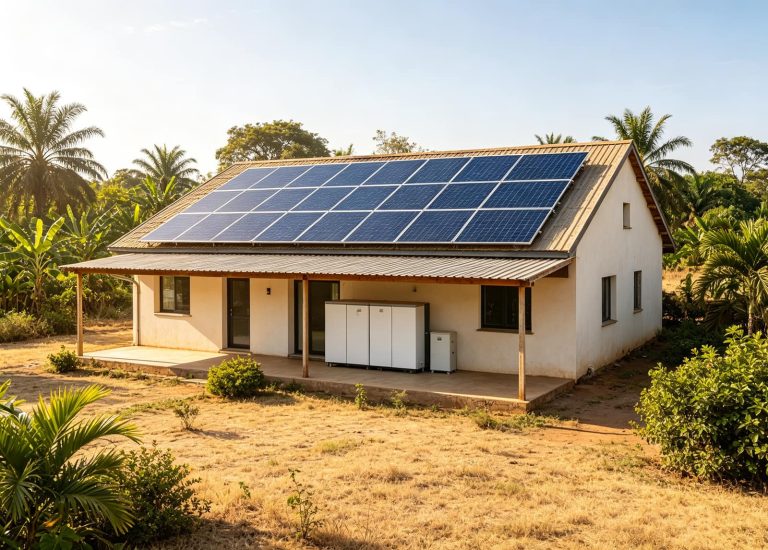
Beyond cities, off-grid solar storage for remote areas is where LFP changes lives. In rural Nigeria — villages without grid extension, farms, telecom sites, Primary Health Centres, and schools — a diesel generator was historically the only option. Today a properly sized LFP + PV system is both cheaper and more reliable.
Typical remote deployments:
- Rural clinics — vaccine fridges and lighting, 5–20 kWh.
- Telecom / BTS sites — 48V LFP banks replacing genSets.
- Farms & agri-processing — water pumps, cold rooms, 10–50 kWh.
- Schools & community centres — lighting, computers, 5–15 kWh.
- Off-grid homes — 5–15 kWh all-in-one or stackable systems.
The key engineering principle for remote sites: oversize the battery, not the generator. A larger LFP bank smooths multi-day cloudy periods and removes the need for any fuel logistics at all.
5. Sizing Your System: A Quick Reference
| Daily load | Recommended LFP capacity | Typical PV array |
|---|---|---|
| Small home (lights, fan, TV, phone) | 5 kWh | 1.5–2 kWp |
| Standard home ( + fridge, freezer) | 10–15 kWh | 3–5 kWp |
| Small business / shop | 15–30 kWh | 5–10 kWp |
| Clinic / remote site | 20–50 kWh | 8–15 kWp |
Rule of thumb: size the battery for 1.5–2 days of autonomy at 80–90% DOD, then size PV to fully recharge it on a good sun day. Nigeria’s high irradiance (4.5–6.5 kWh/m²/day in most regions) makes this very achievable.
6. Climate, Safety & Certification Notes for Nigeria
Nigeria’s heat is a real battery stressor. Practical guidance:
- Install shaded and ventilated. Ambient temperatures of 35–45 °C accelerate ageing; a ventilated, shaded enclosure protects lifespan. Quality BMS units include temperature cut-off and cell-balancing.
- Look for certified products. IEC 62619 (industrial safety), IEC 61000 (EMC), CE marking, and UN 38.3 (transport) are the baseline. For import, confirm SON (Standards Organisation of Nigeria) requirements with your supplier.
- Use a proper inverter/charger and fusing. LFP demands a charge profile matched to 3.2 V/cell; mismatched chargers destroy cells fast.
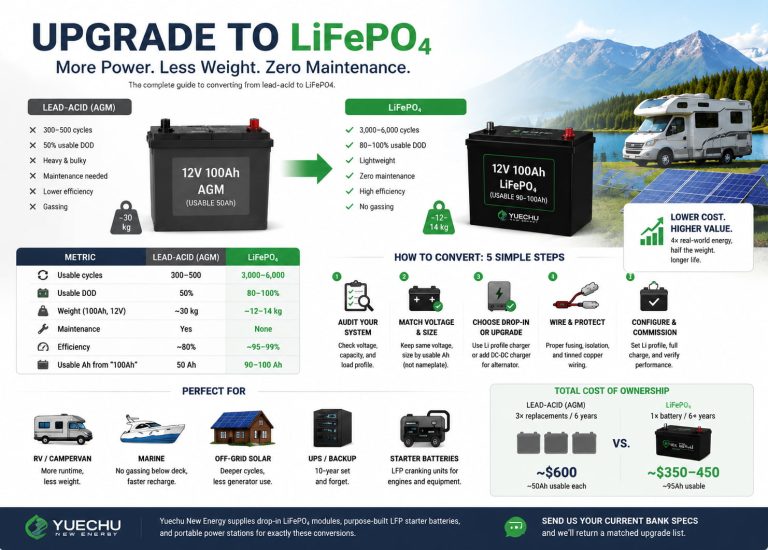
- Lead-acid to lithium conversions: many Nigerian installs replace tired lead-acid banks. Use a boost converter / drop-in LFP solution so the existing 12V/24V system works without rewiring — see Yuechu’s lead-acid-replacement line.
7. CIRCOVAENERGY LiFePO₄ Solutions for the Nigerian Market
CIRCOVAENERGY designs LFP storage built for exactly these conditions:
- Home ESS all-in-one (10 / 15 kWh) — plug-and-play backup for Nigerian homes and offices.
- Stackable wheeled cabinets — scalable 5–50 kWh for shops, clinics, and remote sites.
- 12.8V / 25.6V LFP batteries — drop-in lead-acid replacement, with boost-converter options.
- Portable power stations — for fieldwork, events, and mobile backup.
All systems use intrinsically safe LFP chemistry, smart BMS with temperature and balancing protection, and are built to IEC/CE-aligned safety standards.
Ready to size your system? Tell us your daily load (watts and hours) and whether you are grid-tied backup, fully off-grid, or replacing a generator — we will recommend the right capacity and ship a certified solution.
FAQ
Q: Is LFP safe in Nigeria’s heat?
A: Yes — LFP is the safest lithium chemistry, and with a ventilated, shaded install plus a temperature-protected BMS, it performs well even at 40 °C+ ambient.
Q: How long does an LFP solar battery last?
A: 6,000–8,000 cycles at 80–90% DOD translates to 8–12+ years in daily-use backup scenarios.
Q: Can I replace my diesel generator completely?
A: For most homes and small businesses, yes — a correctly sized LFP + PV system removes the generator except for rare extended outages. Many users keep a small gen only as emergency redundancy.