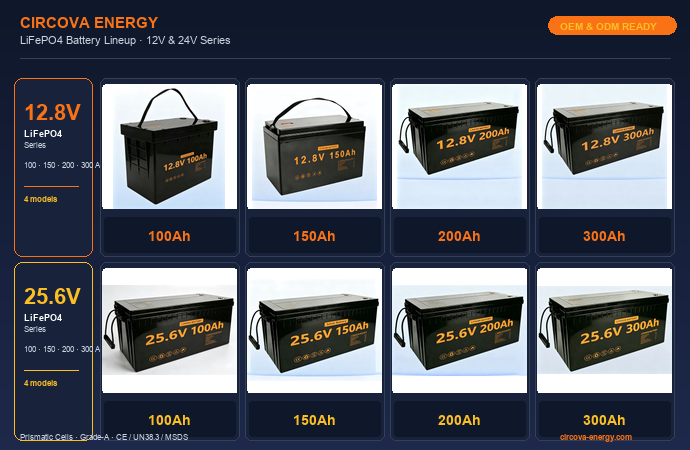
LiFePO4 On the Go: Portable Power & Lead-Acid Conversion Use Cases

Not every battery lives in a garage. Some ride in a truck, sit on a boat, or back up a disaster-relief site. This is where LiFePO4 (LFP) and lead-acid-to-lithium conversion earn their keep — lighter weight, deeper usable capacity, and zero maintenance in places you cannot easily service a flooded battery.
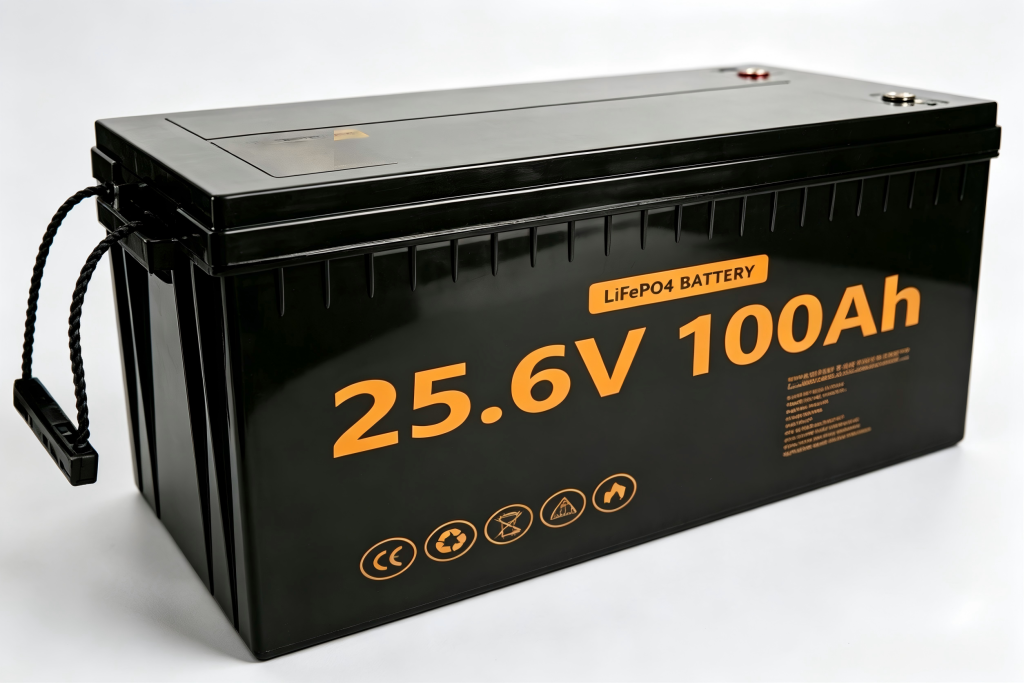
Use Case 1 — Camping & Outdoor Portable Power
A portable LFP power station replaces the noisy generator at a campsite.
- What it runs: fridge, LED lights, laptop, drone, electric grill.
- Why LFP: 80–100% usable depth-of-discharge vs 50% for the same-size AGM; half the weight to carry.
- Typical size: 0.5–2 kWh, 1–2 kW pure-sine output.
Use Case 2 — RV / Campervan (铅改锂 Drop-In)
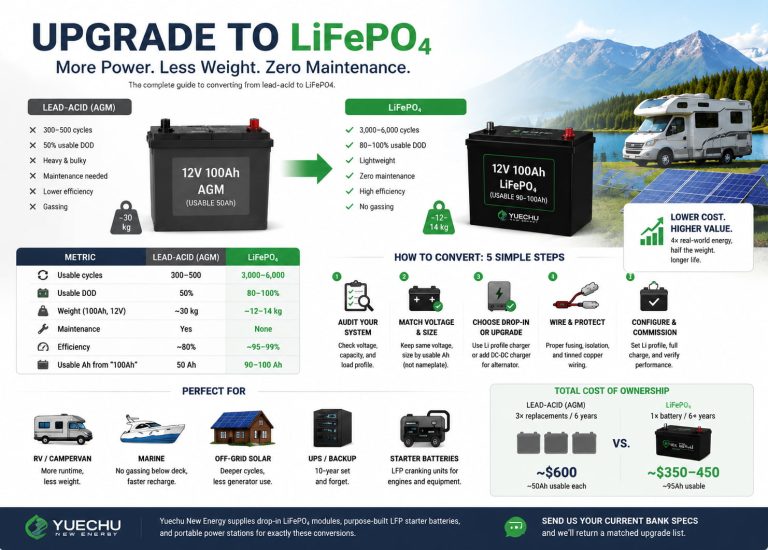
The classic conversion. Swap the house-bank AGM for a drop-in LFP and double boondocking time at half the weight.
- Topology: 12 V / 24 V drop-in LFP with internal BMS; keep a DC-DC charger off the alternator.
- Why it works: a 100 Ah LFP delivers ~95 Ah usable where a 100 Ah AGM gave 50 Ah — roughly 4× real-world energy over the pack’s life.
- Caveat: “dumb” alternators need a current-limited DC-DC charger, or they over-drive the LFP.
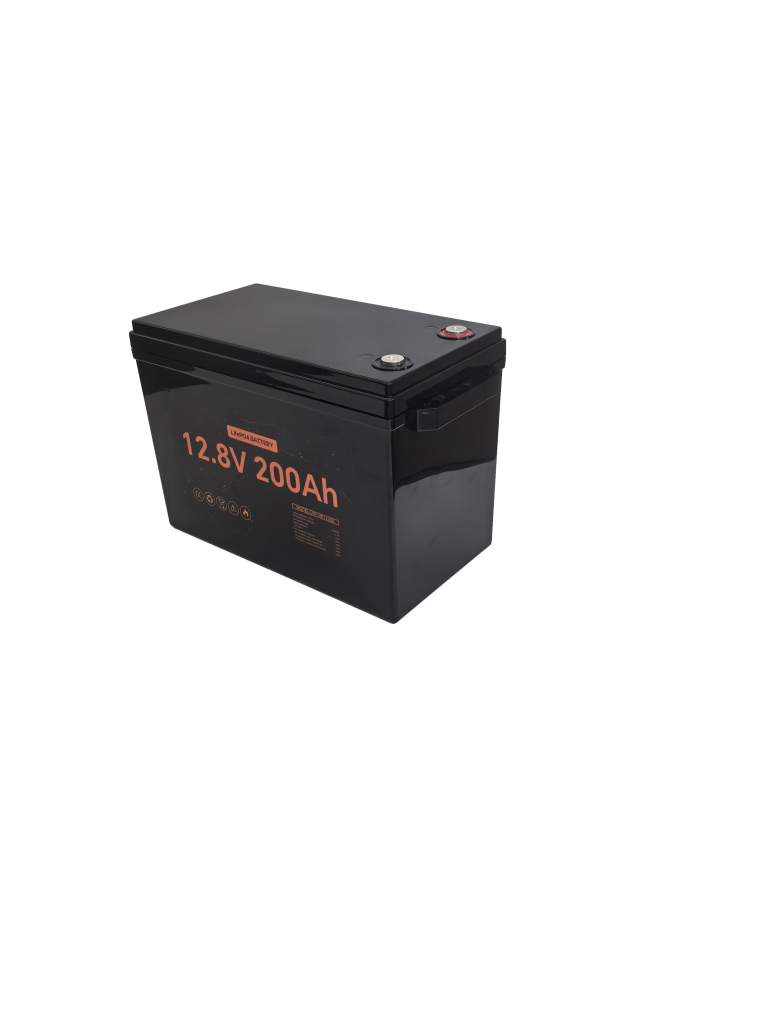
Use Case 3 — Marine / Boat House Battery
Below-deck lead-acid off-gasses hydrogen and needs constant vigilance. LFP removes both problems.
- Topology: tinned-copper cabling, Class-T fusing at the terminal, MPPT on the solar.
- Why LFP: no gassing in a confined bilge, faster solar recharge, longer life in a vibration-heavy environment.
Use Case 4 — Emergency & Disaster Backup
When the grid is down for days, a wheeled LFP unit powers communication and medical loads.
- What it runs: router, phone bank, CPAP, LED lighting, small fridge.
- Why LFP: set-and-forget for years of standby; no equalization, no corrosion to fail at the worst moment.
Use Case 5 — Construction & Field-Site Backup (工程备电)
Remote work sites have no reliable grid. A rugged LFP block runs power tools and site lighting.
- Topology: 12/24 V LFP + pure-sine inverter, or a larger cabinet for three-phase tooling.
- Outcome: replaces daily generator fuel runs; quieter, cleaner, cheaper per kWh over the project.
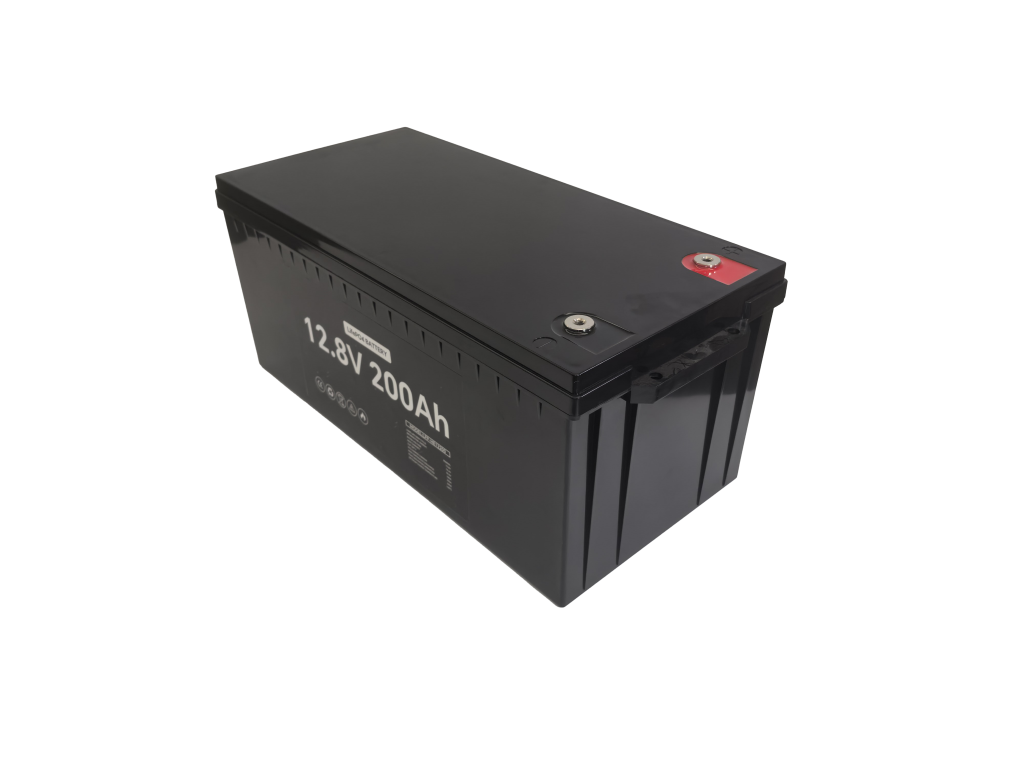
Use Case 6 — Vehicle / Equipment Starting (铅改锂启动电池)
Purpose-built LFP cranking units start diesel gensets, ATVs, and utility vehicles.
- Why a dedicated unit: starter duty needs a high CCA-equivalent pulse current — use a purpose-built LFP starter, not a deep-cycle pack.
- Benefit: weighs a fraction of lead-acid, survives long storage with negligible self-discharge.
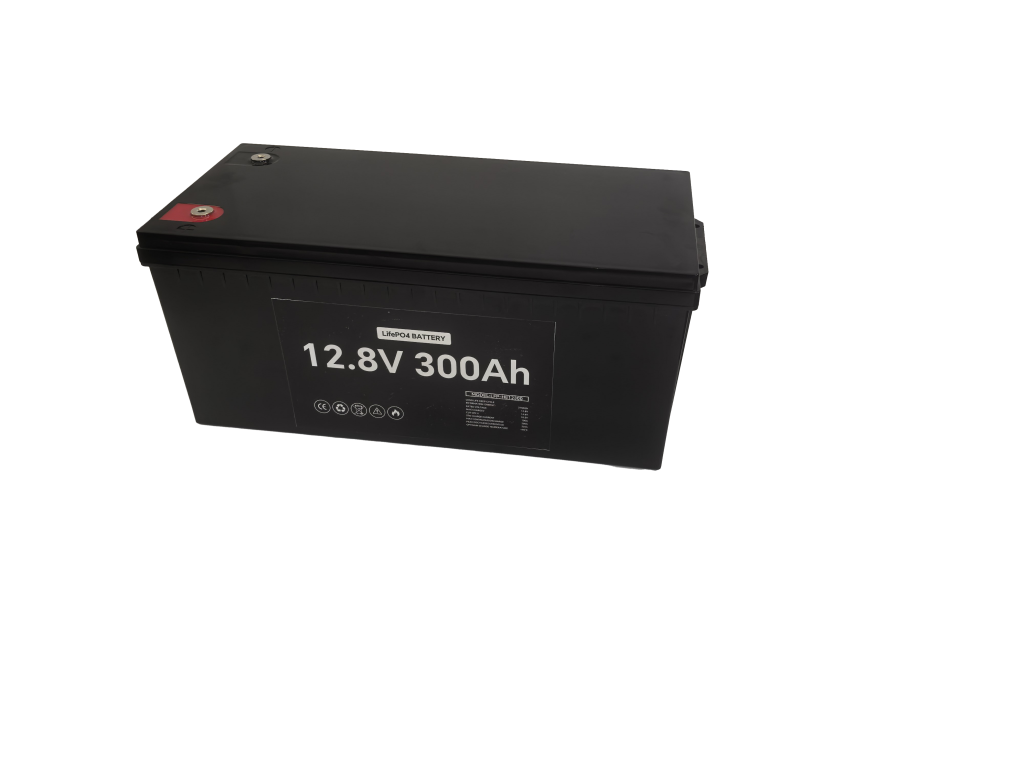
Use-Case Comparison
| Use case | Voltage | Typical size | LFP advantage |
|---|---|---|---|
| Camping portable | 12 V | 0.5–2 kWh | Light, deep DOD |
| RV house bank | 12/24 V | 100–400 Ah | 2× runtime, ½ weight |
| Marine | 12/24 V | 100–300 Ah | No gassing, vibration-proof |
| Emergency backup | 12 V | 0.5–2 kWh | Years of standby, zero upkeep |
| Field-site 备电 | 12/24 V | 2–10 kWh | Beats generator fuel cost |
| Vehicle starting | 12 V | CCA-rated | ½ weight, long storage |
Conversion Safety Reminders
- Never mix old lead-acid with new LFP in one bank.
- Fuse close to the positive terminal — LFP’s low resistance means higher fault current.
- Set the charger / MPPT to LiFePO4 (bulk ~14.4–14.6 V for 12 V; no extended float).
- Engine systems: always insert a DC-DC charger between alternator and battery.
Final Thoughts
Whether it rides in a backpack or starts a diesel genset, LFP is the highest-ROI upgrade for any mobile or backup system. Pick the right form factor — portable station, drop-in module, or purpose-built starter — and let the BMS do the work.
*Yuechu New Energy supplies portable power stations, drop-in LiFePO4 modules, and purpose-built LFP starter batteries for every use case above. Send us your current bank specs and we’ll return a matched upgrade list.*